
Paraguay Tax Residency

Paraguay runs a territorial tax system. Income earned outside the country is not taxed there. Income earned inside it is taxed at a flat ten percent.
That is the whole mechanism, and it is why Paraguay pairs so often with a US LLC.
The company passes its profit through to you, and your residency decides what happens next, which makes forming the company itself the other half of the pairing.
The residency itself takes one to three days on the ground in Asunción, after thirty to sixty days of document preparation. You leave with a valid precaria in hand.
Keeping it asks for one day a year in the country, which is the detail that makes it work for people who do not intend to live there.
The tax number comes last. A one day return visit for the RUC puts the arrangement into effect, and the declarations after that are an accountant's job rather than yours.
What territorial tax actually means
A territorial system taxes where income is generated, not where the person holding it happens to be resident.
In Paraguay local income is taxed at a flat ten percent for residents. Foreign income is not taxed. Non-residents are subject to a twelve and a half percent withholding on Paraguayan-sourced income.
Crypto sits inside the same logic. Paraguay does not tax crypto gains or wealth.
Becoming a tax resident requires either a temporary or permanent residence in the country, or spending at least 120 days there within a twelve month period.
None of that tells you what you personally would owe. Leaving one tax system usually has rules of its own, and those live in the country you are leaving, not in Paraguay. That is the part worth taking advice on.
The residency is three days. The part worth planning is what you are leaving behind.
Book Your Assessment CallThirty to sixty days of paperwork, then three days on the ground
The preparation is the long part and it happens before you fly. Thirty to sixty days to assemble and validate documents.
Then one to three consecutive days in Asunción. Appointments are pre-booked, the documents are ready, and you sign.
You leave with a residencia precaria, which is already valid. The temporary residency itself follows, then the cédula, then a one day return visit for the RUC, the tax number that puts the arrangement into effect.
The team is Paraguayan and the translations are handled, which matters more than it sounds. The alternative is arriving alone and negotiating a government process in Spanish.
Standard and fast track
The difference between the two plans is time and how much is carried for you.
The fast track moves sooner at every stage and carries more of the work for you. The standard route is slower and leaves more of the running in your hands. Add-ons are chosen and paid separately on either.
The grant itself runs on a government timetable rather than a plan. The application goes to the Dirección General de Migraciones, and the decision and its clock are theirs. What sits inside your control is the preparation before you fly and the days you spend in Asunción, and both are above.
Airport pickup, a registered address and a utility bill in your name for opening bank accounts, and the cédula, RUC and an accountant for a year are included.
Banking is included on that route as well: ordinary accounts immediately, and the premium tier after six months of tax filing.
What it turns into
Temporary residency is granted for a year and renews annually for up to three.
Permanence and then the passport follow from there, and First Class Citizen put the passport five years out, earned through the steps in between. The stage-by-stage timings are worth taking from them for your own case.
The passport carries visa-free access to 144 countries and sits inside Mercosur, which is the reason most people treat this as a long game rather than a tax move.
Banking is available to temporary residents with a residency card, passport and proof of address, in guarani, dollars and euros.
First Class Citizen has run more than 200 Paraguayan residencies over the past seven years.
Standard or fast track, and how it pairs with your company. The call settles both.
Book Your Assessment CallWhat it is actually like
Worth knowing even if you do not plan to stay, because the paperwork assumes an address.
Costs are low by regional standards. A decent loft runs around six hundred dollars a month, a well-appointed one closer to twelve hundred. Dinner at a good restaurant is fifteen to twenty dollars a head.
The currency is the guarani. Dollars can be withdrawn from ATMs but are not widely used day to day.
It is considered reasonably safe for foreigners, with the ordinary precautions any unfamiliar city deserves.
What this does not do
Three things this page will not blur.
First, a Paraguayan residency does not by itself end your obligations elsewhere. Exit rules belong to the country you are leaving, and some of them are strict.
Second, the fast timeline describes the in-person portion. The full sequence to a cédula and RUC runs months, not days.
Third, this is a residency, not a citizenship. The passport is five years out, and it is earned through the steps in between.
Client wins from the Hall of Wins


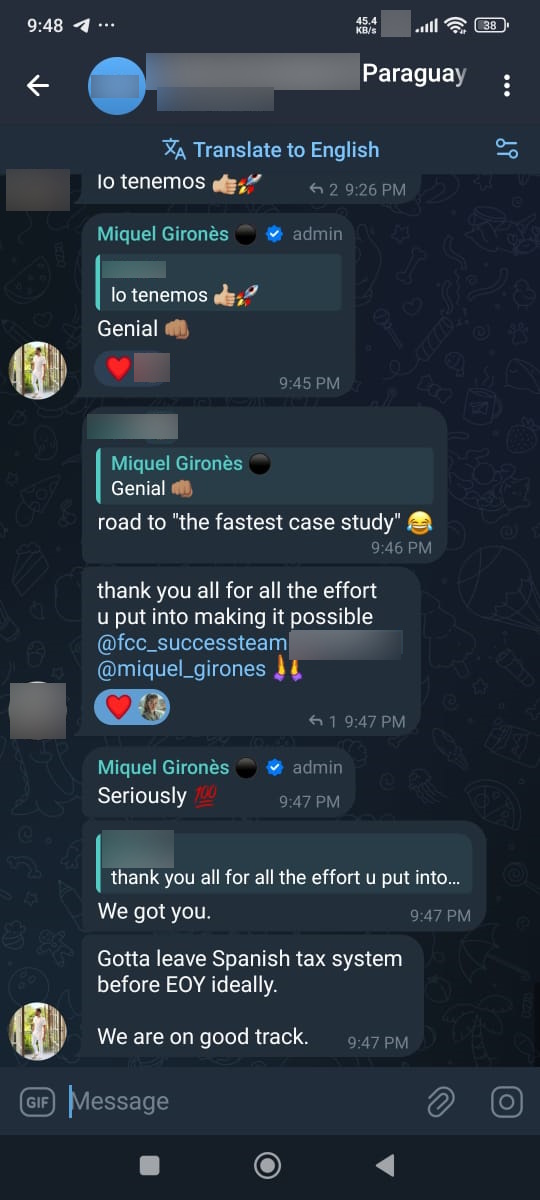
Real client wins, straight from the Hall of Wins.
The rest of the picture
- Find your routeTell it what you are trying to do and it maps the guides to read in order.
- ITIN document checklistPick your situation, get the exact list the IRS accepts.
- What it costsPublished prices and timelines, service by service.
- US credit calculatorWhat your spend returns at the rates issuers publish today.
FAQ
Does Paraguay tax foreign income?
How do I become a tax resident in Paraguay?
Is there a minimum stay to keep the residency?
How long does the process take?
How long until a Paraguayan passport?
Can I open a bank account as a temporary resident?
Are crypto gains taxed in Paraguay?
Find out whether Paraguay is your jurisdiction
The assessment call covers which route fits, how the residency interacts with your company structure, and what leaving your current tax system actually involves. Free, qualified, and direct about what applies to you.
Book Your Assessment CallThis guide reports what the authorities and institutions involved publish, quoted, with the date each source was read. It is not tax, legal or immigration advice. Published rules change, and an individual case can turn on facts no page can see.

Founder & CEO, The First Class Citizen