
Which Structure Do I Need?

Four different things get called a structure, and they solve four different problems. A company you trade through. A personal US tax number. A bank account. A residency that changes where you are resident.
On First Class Citizen's own published wording, a company is not the answer to a tax question. Both of the companies they form are pass-through entities, and both pages carry the same sentence: you pay taxes where you have your residency. The company is what you trade through. For the tax outcome, their own pages point at a residency.
What this page will not do is tell you whether you qualify, or what you personally would owe. Both depend on your own country and your own history, and neither belongs on a page.
Four jobs, not one shelf
First Class Citizen groups what they sell into four blocks, and the same grouping appears on their company pages and again on their consultation page. Passports and residencies: Paraguay residency and citizenship, Mexican passport and residency, Panama residency. Business incorporations: a US LLC, a United Kingdom LLP, a Panama LLC and others. American banking access: an ITIN, opening American bank accounts, and access to American credit. And network access: real estate investment, bank relationships, a lawyers network.
Read that as four jobs rather than a shelf of products and most of the confusion goes. The four blocks describe four different objects.
- A company is the thing a business invoices, contracts and banks through.
- A personal tax number is what American banking and credit in your own name run on.
- An account is somewhere to hold and move money, and an account is not a tax position.
- A residency is a different answer to where you are resident, and it is the slowest of the four.
A company, a tax number, an account and a residency solve four different problems. Fifteen minutes settles which one is yours.
Book Your Assessment CallWhat their pass-through wording actually says
The sentence worth reading twice is theirs rather than ours. Their LLC page states that the LLC is a pass-through entity and that as a non-US citizen you pay taxes where you have your residency. Their LLP page carries the same construction for the partnership. Pass-through, in their framing, means the entity is not taxed at that level and the profit is reported by the owners, in the country where they are resident.
Which is why both pages point at the same next step rather than at another entity: a residency in a territorial tax country, where only locally generated income is taxed. The pairing they publish by name is Paraguay, and they call it their favourite combination.
So the company is not the lever their own material puts forward for a tax outcome. It is the thing you trade through, and it carries limited liability, which is reason enough to exist on its own. Their published wording for that is to protect your assets and wealth, with limited liability in case something goes wrong.
What any of it means for you depends on where you are resident now, what your current country does when someone leaves, and where your customers sit. None of that is a page-level question.
Which of the two, and what separates them
They form two, and most of the list is common ground. Both run on the same clock and carry the same wrapper: a two minute form, a payment, incorporation documents inside 24 to 48 hours, a registered agent, a virtual address, direct access to Miquel Gironès' team on Telegram, and the annual filing carried under the yearly maintenance fee with the first year included. Both are published at the same figures, covered at the end of this page. So the differences are short, and they are structural.
The US LLC needs no second partner, and it has a jurisdiction to choose. Wyoming is their recommendation on lower annual operating costs and flexibility, with no corporate income tax and no annual franchise tax. Delaware is their recommendation for a startup ecosystem, and their FAQ adds the line that usually settles it, in their own words: investors prefer Delaware, if you are going to look for angel investors or venture capital.
The UK LLP is a partnership, so it must have at least two partners, all of them limited partners. They can be natural persons, legal entities such as a holding company, or a mix, and there are no residency requirements for any of them. For a single owner, one of their own limited companies takes the second seat at zero percent ownership, so the structure holds and you still own one hundred percent of the company and its profits.
Banking is where the two routes visibly part. On the American side, their page states that with the EIN you can open three online bank accounts at no cost, naming Wise and Mercury, plus US local-branch accounts on a single visit in person. On the British side, their own FAQ says non-residents will often struggle to open accounts for their LLP with the large UK banks, and recommends fintech instead, naming Wise, Revolut and Juni.
One published condition on the UK side has no American equivalent. Their FAQ states that a UK LLP can conduct business in the UK without restriction, that doing so will usually create a tax burden in the UK for the partners, and that selling to UK customers from abroad may still create a UK VAT liability depending on what is sold. Whether that describes you is a call question. The UK LLP guide covers the other half.
What is fast, and what is not
Sequence decides more than most people expect, because the four pieces run on wildly different timescales. The company is the fast one. Both structures are formed inside 24 to 48 hours after a two minute form and a payment, and their LLP FAQ goes further: online accounts can be opened right away, and in two days you can already be receiving money into the new LLP.
The American company's second number is slower. A US LLC needs an Employer Identification Number before the useful part starts, and it is the number that opens US bank accounts and payment processors such as Stripe and PayPal. Their LLC page publishes two to three weeks for it. Their own LLC FAQ publishes three to four. Both are live, so plan in weeks and ask for the current figure for your file.
The personal tax number is slower still. Their published window for the ITIN is 45 to 60 days, stated in four places on the page, and the number they deliver is valid for three years.
The residency is the slowest by a distance. Paraguay is a document-preparation period before you fly, then one to three days in Asunción, then the temporary residency, granted by the Dirección General de Migraciones on its own timetable, and the cédula after that. Their two plan pages and their FAQ publish that window differently, Fast Track shorter than Standard.
Their own terms frame every number above: completion time depends on the service selected and the estimate is communicated before the purchase. The window that counts is the one given for your file.
The company and tax-number figures are published. The residency numbers are quoted, so ask for them early and in writing.
Book Your Assessment CallThe personal number and the company number are not the same thing
Two numbers get confused constantly. The EIN belongs to the company. The ITIN belongs to you. Their own page describes the ITIN as the equivalent of a Social Security Number for non-residents, which is exactly the job it is doing.
Their published ladder runs in one direction. Request the number. Then open US bank accounts and get your first credit cards, with Bank of America, Chase, JP Morgan and Wells Fargo named on their page. Then build the credit file. Then combine the setup with an LLC for business funding and multiple business credit cards.
From the company's side the relationship reads the other way round. On their LLC page the ITIN is published as optional: it is what opens US corporate accounts in person and the gate to the credit lane, not a requirement for the company to exist.
What they publish as required is short. The applicant must not be eligible for a Social Security Number, which in their wording means not a US resident, citizen or green card holder. The documents are a passport photo or scan, a non-US address, and an email. The application needs no US travel, in their words no need to step into the USA or being resident, although their own second step is flying to the US to open the accounts.
Anything past that one published eligibility line depends on your own country and history, and gets settled on the call rather than here.
The residency, and the gate in front of it
This is the one their company pages point at, and the one they publish in most detail. Paraguay runs a territorial system. Income earned outside the country is not taxed there, and locally generated income is taxed at a flat ten percent for residents. The in-person part is one to three days in Asunción, with the document preparation done before you fly.
Their compliance line is worth quoting rather than paraphrasing: all processes are legal, in their words the white area, and properly registered in the official government system.
Two plans are published. On Standard, the add-ons are not included, chosen and paid for separately. On Fast Track, airport pickup, a registered address and a utility bill in your name, the cédula, the tax number and an accountant for a year all sit inside it, along with a banking line. Each plan page publishes its own processing window, and the FAQ a third, so the one that binds a file is the one their team quotes for it.
Then the gate, which is theirs and not ours. Asked directly whether someone can go straight to the Paraguay service, their published answer is no: the first step is a conversation, to check the residency is viable for that person and does not conflict with the rest of the plan. The company and the tax number have a direct application route. This one does not, by their own rule.
They publish more than two hundred Paraguayan residencies over the past seven years, in two places on their site. What is on no page at all is what leaving your current tax system involves, because those rules live in the country you are leaving.
The questions that route to a person
The boundary of this page, stated in the open rather than buried. Six questions decide most files, and not one of them has a published answer, because every one is about you.
- Whether you qualify at all. The tax-number lane publishes a single eligibility line and the residency lane publishes none.
- Whether a US citizen or a US resident can buy the company products. Every published framing is written for a non-US citizen, and nothing published says either way.
- What leaving your current tax system involves. That is your current country's rule, not theirs, and some of those rules are strict.
- Which documents your own residency file needs. Their Paraguay FAQ carries more than one answer to that question, so there is no page-level version of it worth trusting.
- Whether what you sell raises a UK VAT question. Their own LLP wording opens that door and does not close it.
- What happens if an application is refused, and what that costs. No policy is published in either the residency or the tax-number lane.
None of that is a stall. It is the actual shape of the decision, and fifteen minutes with someone who has run the file before resolves more of it than any page can.
A company, a tax number, an account and a residency solve four different problems. Fifteen minutes settles which one is yours.
Book Your Assessment CallWhat is published, and what is quoted
Left until last on purpose, because the number is rarely what decides it. The two companies carry the same published figures: a one time set-up fee of $1,000 and a yearly maintenance fee of $299, with the annual filing and paperwork sitting under that maintenance fee and the first year included. The same numbers appear on both pages, which is the clearest evidence available that price is not what separates a US LLC from a UK LLP. The ITIN service is $1,000, valid for three years, at the same renewal price, with no maintenance cost.
The residency is the one with no published figure at all. Neither Paraguay plan carries a price, and nor do the add-ons a Standard buyer is told to pick and pay for, among them the cédula, the tax number, the registered address, the monthly filing, the bank accounts and the driving licence. Those are quoted rather than published, which is a reason to ask for them early and in writing.
Two published policies to know before paying anything. Their brand does not offer discounts, though they say they are open to bonuses, gifts or credits toward future services on specific occasions, particularly for existing clients. And on their terms, a refund request can be initiated within one business day of payment if a mistake has been made by the customer, assessed case by case, while cancellations are considered on the validity of the reason given and are not refunded once processing has commenced.
What is not published anywhere, and worth asking for by name, is which filings the yearly fee covers and when it is first charged. The line the pages carry is that the first year is included, and they stop there.
Files that closed







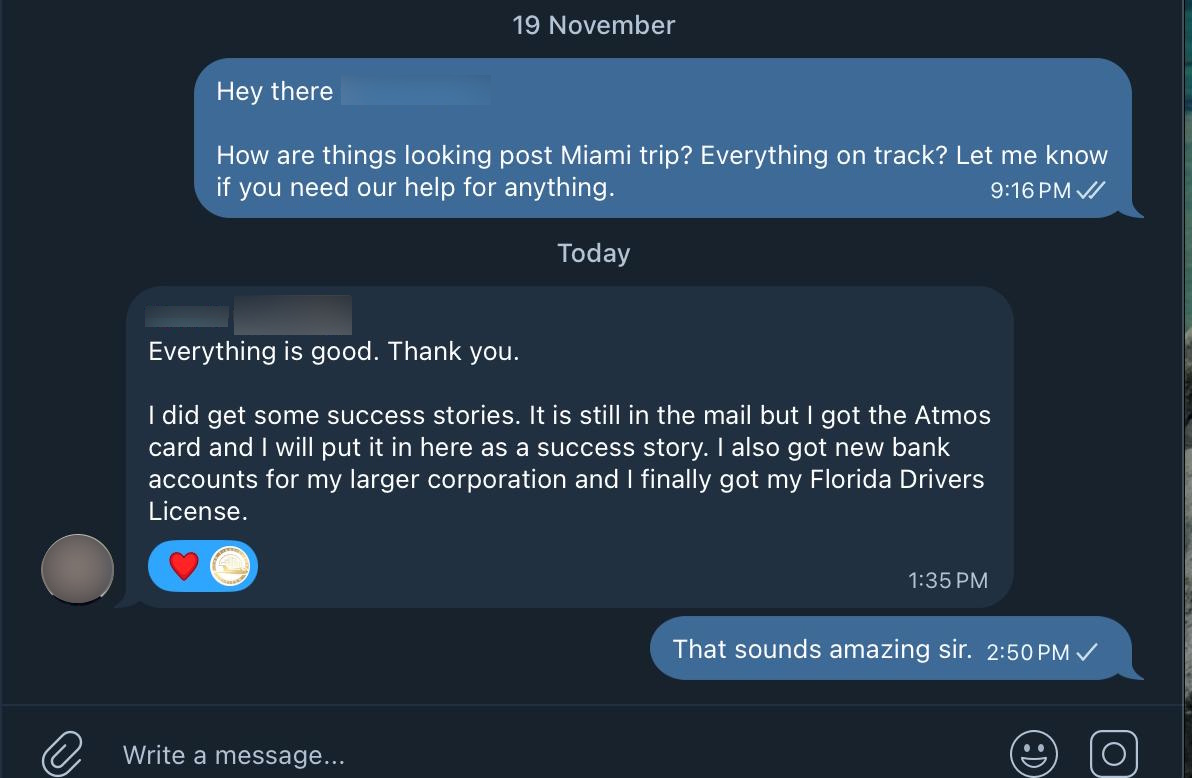



Real client wins, straight from the Hall of Wins.
The rest of the picture
- Find your routeTell it what you are trying to do and it maps the guides to read in order.
- ITIN document checklistPick your situation, get the exact list the IRS accepts.
- What it costsPublished prices and timelines, service by service.
- US credit calculatorWhat your spend returns at the rates issuers publish today.
FAQ
Do I need a company or a residency?
Will a US LLC lower my tax?
Do I need an ITIN if I have an LLC?
Which one is fastest?
Can I buy the Paraguay residency directly?
Which structure do I need for a US bank account?
What does each one cost?
What if I need more than one of them?
Find out which one you actually need
The assessment call establishes which of the four you are really after, what has to run before what, and the figures the pages do not publish. Free, qualified, and direct about the parts that do not apply to you.
Book Your Assessment CallThis guide reports what the authorities and institutions involved publish, quoted, with the date each source was read. It is not tax, legal or immigration advice. Published rules change, and an individual case can turn on facts no page can see.

Founder & CEO, The First Class Citizen