
Paraguay, Panama, Georgia: Three Services, Two Different Jobs

These three get shopped against each other as though they were rival products. They are not competing. Paraguay is a tax residency. Panama and Georgia are bank accounts.
That single distinction decides most of the question. A residency changes where you are resident. An account gives you somewhere to hold and move money. Buying the second when you needed the first is the common and expensive mistake.
The two accounts then split on one published fact, and First Class Citizen states it themselves on their own Georgia page: the Panama account takes deposits made directly in crypto, and the Georgia account does not.
Time separates them too. Georgia publishes two business days once the documents arrive. Panama publishes three to five business days. Paraguay is thirty to sixty days of paperwork before you fly, then one to three days on the ground, with the residency itself landing months later.
One of these three is not a bank account
Everything downstream follows from this.
Paraguay is a residency. It changes your status in a country. First Class Citizen publishes that Paraguay taxes on a territorial basis, that income from abroad is not taxed there, and that local income is taxed at a flat ten percent for residents. The service runs an immigration file through the Dirección General de Migraciones and ends in a cédula and a tax number.
Panama and Georgia are accounts. Both are opened without residency in the country. First Class Citizen publishes that Panama ties are not required, while noting that having them raises the chance of a successful opening, and states plainly on the Georgia page that Georgian ties are not required to open successfully either. Neither account is an immigration process and neither one moves your status anywhere.
So the useful question is not which of the three is best. It is which of two problems you actually have. If the problem is where your income is taxed, that is the residency lane and only the residency lane. If the problem is that you have nowhere sensible to hold money, or that your source of funds keeps closing doors, that is the banking lane, and then the choice narrows to two.
One of these three is a residency. The other two are accounts, and an account is not a tax position. Fifteen minutes settles which one you need.
Book Your Assessment CallWhat the Paraguay residency is for
Paraguay is the only one of the three that touches your tax position, and First Class Citizen is specific about the mechanism.
They publish that as a territorial-tax country Paraguay does not tax income from abroad, and their surfaces give the tax-residency test in two forms: holding a temporary or permanent residence in the country, or spending more than a hundred and twenty days there in a year. They also publish that a resident holding only the residency, the ID and the RUC, and generating no local income, has no requirement to file tax returns there, and the same answer continues that a self-employed professional working from abroad informs the bank about the origin of the money and makes a monthly VAT declaration. Both halves are theirs. What any of it means for you personally depends on where you are resident now and what your current country does when you leave, which is a call question rather than a page claim.
The process is a file, not a purchase. Thirty to sixty days of document preparation before you travel, a minimum of one week between placing the order and the travel date so the immigration appointment can be scheduled, then one to three days in person in Asunción. You leave with a residencia precaria that is already valid.
Two published routes sit behind that. On the Standard plan the add-ons are chosen and paid separately. On the Fast Track the cédula, the RUC and an accountant for a year are included, along with a banking line: ordinary accounts immediately, and the premium tier after six months of tax filing. On either route the temporary residency is granted by the Dirección General de Migraciones on its own timetable, and the cédula follows it; the two plan pages and their FAQ publish that window differently, so the one that binds a given file is the one their team quotes for it.
The RUC, the Paraguayan tax number, is collected on a separate one-day return visit, on the sales page's own count. Their FAQ describes the travel differently, and their pages add a later return to convert the temporary residency into permanent. The trip arithmetic for a given file is theirs to confirm before anyone books.
What the Panama account is for
The Panama account solves a narrower problem than banking in general, and naming it plainly is the fastest way to know whether it is yours.
It accepts crypto as a declared source of funds. First Class Citizen publishes that this account allows crypto to be the source of funds, deposits made directly in crypto, swapping between stablecoins and dollars at will, and transacting freely to and from exchanges worldwide. Stablecoin deposits in USDC or USDT are published as landing in under thirty minutes. If crypto-related activity is what has been closing accounts on you elsewhere, that is the whole reason this one exists.
The opening normally requires a visit to Panama City. A long-standing relationship with the bank lets the process run remotely instead, over a video call from wherever you are, with the card shipped anywhere in the world. A form of about two minutes, a passport copy, a bank statement and a crypto address is the published input list.
What lands is checking, savings and investment accounts in dollars, euros, bitcoin and USDC, with the debit card, in three to five business days.
The bank itself is a private family institution with more than fifty years of operating history in the Panama banking sector. First Class Citizen does not publish its name, and says so directly: the name is part of their know-how. Worth knowing before you ask.
What the Georgia account is for
Georgia answers a different question. Not how do I bank crypto income, but how do I hold three currencies in one place with a European payment rail attached.
The published output is an IBAN that sends and receives US dollars, euros and Georgian lari. Euros move through SEPA as instant transfers. Dollars cover worldwide transfers. The lari is the currency the deposit interest sits in, and First Class Citizen publishes the rates as one to two and a half percent on dollars, a tenth to half a percent on euros, and seven and a half to eleven percent on lari. Those are rates as published on their page, and rates move, so treat them as a starting point for the conversation rather than a fixed term.
The opening runs on paper. A form of under five minutes with a passport copy and a bank statement, payment, then the opening documents are filled out, sent digitally for verification, and mailed physically to their address in Georgia, where their Georgian partners translate and certify them. Remote opening runs on a power of attorney, and First Class Citizen publishes that the bank does not require proof of tax residency to open. Two business days from the day the documents arrive, the IBAN and the debit card are ready.
Around the account sits the part that is genuinely distinct: a vetted private banker reachable directly on WhatsApp, a mobile app built to run the account without a branch visit, checking, savings and investment accounts with an optional brokerage account, and an optional card stack applied for separately and delivered a week after, carrying access to thirteen hundred airport lounges, a fast-track lane at Tbilisi and a round-the-clock concierge.
The set-up figures are quoted, not published. Ask for them on the call, early and in writing.
Book Your Assessment CallThe one published difference that decides between the two accounts
If you have narrowed it to banking, this is the sentence that settles it, and it is First Class Citizen's own.
On the Georgia page they publish an honest list of that account's drawbacks, and the first item on it reads that the Georgia account does not offer direct deposits in cryptocurrencies, unlike the Panama account. The same list states that fees are higher than fintechs or crypto platforms, that Georgia shares tax information through CRS and FATCA, and that the opening process takes time because documents must be sent by mail.
That does the comparison work for you. Crypto arriving as crypto is Panama. A multi-currency IBAN with SEPA behind it, a banker on WhatsApp and interest on deposits is Georgia.
The reporting question splits the same way, and only half of it is published. First Class Citizen answers it explicitly for Georgia, naming FATCA, naming CRS, publishing Georgia's double taxation treaty list, and stating that whether Georgia reports depends on the tax residency declared at account opening. For Panama, their pages publish no comparable CRS or FATCA answer. That means it belongs on the call, and it means nobody should infer an answer from the silence, in either direction.
On camera, Miquel Gironès puts it this way, at 1:29 of Why Wealthy People Are Moving Their Money to Georgia:
Georgia is crypto friendly, but in my experience, Georgia has more regulations. So, for example, they will ask you for the proof of the funds. The KYC is stricter.
How long each one takes, on their own published numbers
Start dates are what you control. These are the durations as First Class Citizen publishes them.
- Georgia, the account: a form under five minutes, then the opening documents go by post. Two business days from the day those documents arrive to the IBAN and debit card. No figure is published for the postal leg itself, so the two-day clock starts on arrival, not on payment.
- Georgia, the cards: optional, applied for separately, delivered one week after.
- Panama, the account: a form of about two minutes, then three to five business days to the dollar and crypto accounts and the debit card. The credit card application follows a few days after that.
- Paraguay, before you fly: thirty to sixty days of document preparation, and a minimum of one week between the order and the travel date.
- Paraguay, on the ground: one to three days in Asunción. You leave with a precaria that is already valid.
- Paraguay, after you leave: the temporary residency, granted by the Dirección General de Migraciones on its own timetable, then the cédula. Their plan pages and their FAQ publish that window differently.
- Paraguay, the RUC: a separate one-day return visit.
The accounts are measured in days. The residency is measured in months, with more than one trip on their own published numbers.
What is published, and what is quoted on the call
Price comes last here on purpose, because the number means nothing until you know which of the two problems you are solving. What follows is what First Class Citizen publishes, and nothing else.
- Panama account: a fifty dollar minimum opening deposit, and zero yearly maintenance costs. A deposit of fifteen thousand dollars qualifies you for the Visa Infinite credit card with lounge access, TSA PreCheck and a concierge. The one-time set-up payment is not published on the page. It is quoted on the call.
- Georgia account: a fifty dollar minimum opening deposit, and low wire fees with no numbers attached to that phrase. Neither the one-time set-up payment nor the yearly maintenance figure is stated here, because neither is settled in published form. Both are quoted on the call.
- Paraguay residency: no price is published for either the Standard or the Fast Track plan. Both plan buttons route to their team, which is where the figure comes from.
Two things are worth saying about those blanks rather than papering over them. The first is that a set-up fee you cannot find on a page is not a fee that does not exist, so ask for it early and in writing. The second is that the Paraguay plans differ in what is included as much as in speed, and the Fast Track carrying the cédula, the RUC and a year of accounting is the part that makes a price comparison between the two plans meaningful at all.
Separately, and often confused with the service price, First Class Citizen publishes what the cost of living in Paraguay looks like: around six hundred dollars for a decent loft, closer to twelve hundred for a well-appointed one, and fifteen to twenty dollars a head for dinner at a good restaurant. That is the cost of being there, not the cost of the file.
One of these three is a residency. The other two are accounts, and an account is not a tax position. Fifteen minutes settles which one you need.
Book Your Assessment CallWhat none of the three does
Four limits, and each one is First Class Citizen's own published position rather than a hedge added here.
An account is not a tax position. Asked directly whether a bank account in Georgia will help you pay less tax, their published answer is that will depend on where you are a tax resident. Where you pay tax follows your residency, not the country your money sits in. That is precisely why the residency lane and the banking lane are separate lanes.
The residency is not free movement. Asked whether Paraguayan residency gives visa-free access to the rest of Mercosur the way an EU residence permit gives Schengen access, their published answer is not with residency, yes with passport. Mercosur belongs to the passport, and the passport is a separate road with in-person steps of its own, which is why no passport timeline appears on this page.
The bank decides, not the agent. On the Georgia page First Class Citizen publishes that the final decision on accepting a client application rests with the bank or brokerage, that to date there have been no rejections where the required documents were submitted correctly, and that in the event of non-acceptance they may offer a partial refund of the order minus service fees. That is the Georgia lane. For Panama, ask what happens if an application is declined after payment, because that answer is settled on the call rather than on the page.
Some applicants are excluded outright. Both banking pages publish restricted countries, Syria, Iran and Afghanistan among them, and both publish that company openings for non-resident entities are assessed case by case. Whether that catches you is a fact about your passport and your file, not about the product, and it is the first thing worth settling before anything is paid for.
Client wins from the Hall of Wins


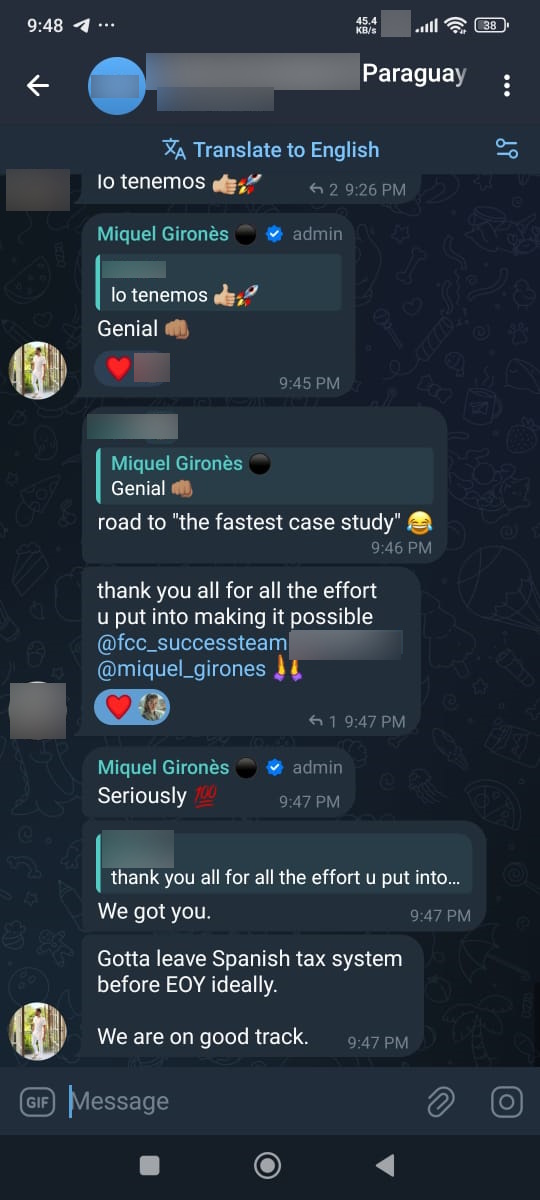
Real client wins, straight from the Hall of Wins.
The rest of the picture
- Find your routeTell it what you are trying to do and it maps the guides to read in order.
- ITIN document checklistPick your situation, get the exact list the IRS accepts.
- What it costsPublished prices and timelines, service by service.
- US credit calculatorWhat your spend returns at the rates issuers publish today.
FAQ
Do I need all three?
Which of the three changes what tax I pay?
What is the actual difference between the Panama account and the Georgia account?
How long does each one take?
Do I have to travel for any of them?
What does each one cost?
Does Paraguayan residency give me visa-free access to Mercosur?
Can a non-resident open both accounts?
Sources
The published pages this guide draws on, each read on the date shown.
- youtube.com read 2026-08-30
Work out which of the three you actually need
The assessment call establishes whether your problem is a residency or an account, which of the two accounts fits how your money arrives, and what the numbers are that the pages do not publish. Free, qualified, and direct about the parts that do not apply to you.
Book Your Assessment CallThis guide reports what the authorities and institutions involved publish, quoted, with the date each source was read. It is not tax, legal or immigration advice. Published rules change, and an individual case can turn on facts no page can see.

Founder & CEO, The First Class Citizen