
Mexico and Paraguay: Two Residencies Sold for Two Different Reasons

Both are Latin American residencies run by the same firm. They are not sold for the same reason, and that is the entire comparison.
Paraguay is sold as a tax position, with the mechanism published rather than implied. Local income taxed at a flat ten percent for residents, and foreign income at zero.
Mexico is sold as permanence and access. Permanent residency that legally never expires, and a passport that opens two years after it.
Only one of the two funnels publishes a tax rate. The other answers the tax question by pointing at a consultation.
Price comes last here, and it is short, because almost nothing is published.
What each one is actually sold for
First Class Citizen sell Paraguay as a tax position and publish the mechanism outright. Paraguay taxes on a territorial basis: local income at a flat ten percent for residents, foreign income at zero, and non-residents subject to a twelve and a half percent withholding on Paraguayan-sourced income. Their published test for tax residency there is holding a temporary or permanent residence in the country, or spending at least a hundred and twenty days inside a twelve month period. That is the test for becoming a tax resident, and it is a separate question from what keeping the residency itself asks of you.
Mexico is sold as something else. Those pages lead on lifestyle, investment and access, on one document that opens the country forever, and on a passport at the end of the road. The plan card says it in four words: stay in Mexico forever.
What is absent from the Mexico lane matters as much. No territorial system, no rate on foreign income, no day count. Its one tax statement is about citizenship rather than residency, and points at a conversation instead of a number: depending on your ties to the country, becoming a citizen can create a tax liability, and their advice is to book a consultation with Miquel Gironès and plan it well before moving forward with a passport.
The split is theirs, not ours. One funnel publishes rates, the other publishes permanence, and both publish their volume: more than 1,000 Mexican residencies in the last nine years, more than 200 Paraguayan residencies in the last seven, each under the same claim, that all processes are legal and properly registered in the official government system.
One of these is sold as a tax position and the other as permanence. Which problem you have decides the rest.
Book Your Assessment CallWhat you are left holding at the end
Both roads run through a temporary status into a permanent one and then to a passport. The published clocks are not the same shape.
In Mexico, temporary residency is valid for four years, and their answer about the end of it is direct: in four years you can turn it into permanent residency, which once granted legally never expires. The passport opens two years after permanent residency, or after a year of marriage, or through a child born in Mexico, and their card states visa-free access to more than 151 countries plus dual citizenship allowed. That test appears twice on the same page in versions that differ by a full year on the marriage route, so the current wording is worth confirming rather than picking the friendlier one.
Paraguay publishes a longer road. The temporary residency is granted for a year and renews annually for up to three, and permanence and the passport follow from there. Take the stage timings from First Class Citizen for your own file, because the route varies by category.
One more line belongs here, and it is the most misunderstood in the lane. Asked whether the residency gives visa-free access to the rest of Mercosur the way an EU permit gives Schengen access, their answer is: not with residency, yes with passport. The visa-free count published beside it, 144 countries, carries no date and no source.
What each one asks for on paper
Here the two funnels are furthest apart.
Mexico publishes the same requirement three times for three routes. Temporary residency, permanent residency after four years of temporary, and permanent residency taken directly where you qualify: a passport scan, in all three cases. The work visa is the exception and it is exacting. A contract with a Mexican employer who has already hired you, an invitation letter from that employer, who must be registered with the Instituto Nacional de Migración and whose letter must carry the contract duration and start date, and an appointment at the closest consulate. Their warning there is blunt: if some step, document or part of the document is missing, the work visa will be rejected.
For Paraguay the application goes to the Dirección General de Migraciones, and yellow fever vaccination is published as mandatory fifteen days before arrival. Take the current document list from First Class Citizen directly, because it varies by residency category.
Two gaps are worth naming. Neither lane publishes a financial minimum, and the criteria behind Mexico's direct permanent residency route, described only as if you qualify, are not published anywhere. Which set applies to a file is a question for them, not for a page.
The published timelines, and where they disagree
Both funnels carry more than one number for the same step. Naming that beats quietly picking one, because the figure worth planning around is the one they confirm for your file.
Mexico, as published:
- Temporary residency: three figures. Under a week on the main page, one week in the FAQ, thirty business days on the plan card of that same main page.
- Permanent residency: three to five business days in person, two weeks where it follows four years of temporary, thirty business days on the plan card.
- Permanent residency taken directly: ten days in the Riviera Maya with their team including biometrics, or thirty days in another state, which requires flying there.
- The passport: no timeline anywhere in the lane. Not on the main page, not in the FAQ, not on a card.
Paraguay, as published:
- Before you fly: thirty to sixty days to prepare documents, stated twice on the main page. Their FAQ gives a different figure for the same gap, a minimum of one week's notice between the order and the travel date.
- On the ground: one to three days in Asunción. You leave with a residencia precaria that is already valid.
- Their Standard plan: temporary residency in three to four months, the Cédula sixty days after.
- Their Fast Track plan: temporary residency in thirty to forty five days, the Cédula fifteen days after.
- Elsewhere on the same funnel: a five-step block giving thirty to forty five days then fifteen to thirty more to every reader, which is the Fast Track window on a page selling both plans, and an FAQ giving about three months to temporary residence then another two for the ID card.
- The RUC: a separate one-day return visit.
Travel splits the same way. Paraguay's published travel starts at two trips, one to three days in Asunción and then the one-day return for the RUC, and their surfaces describe further trips, including a later conversion visit, so the count is worth confirming before booking. Mexico leaves it open: their process step reads visit the consulate or come to Mexico to finalise your process, if not one hundred percent remotely, and which routes run remotely is never resolved.
The reading that fits both sets is that the short numbers describe the appointment and the long ones describe the file. That is a reading, not a published fact. Both FAQ posts are dated June 2023, so every timeline drawn from either is three years old.
Neither funnel publishes a price, and their own Paraguay answer is that the consultation cannot be skipped. Fifteen minutes gets you both numbers.
Book Your Assessment CallWhat is published about price, and what is not
What sits inside each plan comes first, because comparing two entry plans on price alone compares two different things. On both funnels the entry plan is the status and nothing else. Mexico's temporary residency card states that add-ons are not included and are picked and paid for as you choose, with the CURP included on the permanent card. Paraguay Standard says the same and keeps the Cédula and the RUC on its add-on menu, while Fast Track bundles the Cédula, the RUC and an accountant for a year.
Now the number, and this is the shortest part of the page because there is very little of it. No absolute figure is published anywhere in either lane: not the Mexican residencies, not the passport, not either Paraguay plan.
Mexico publishes one price statement, on the citizenship card: price after consultation. Two relative ones sit in their FAQ post. The thirty day direct permanent residency route in another state is published at half the price of the ten day Riviera Maya route. And the student, tourist and investor visas are published at the same price as the temporary residency when applied for from outside Mexico, higher and bespoke from inside.
Paraguay publishes nothing on either plan, and nothing on any of its ten add-ons: monthly tax filing for a year, the Cédula, the RUC, a registered address, a rental agreement, a police signed proof of address, a utility bill, bank accounts, driving licences, and investment and real estate. That lands hardest on Standard, whose own line is that add-ons are not included and you pick and pay as you choose, because the Cédula and the RUC are both on that menu. A Standard buyer cannot build a total from the page.
One figure does exist in that lane and it is deliberately not repeated here. It sits in a June 2023 FAQ post, under a differently named offer written for a different market, and what it bundles, an airport pickup and the ID card, is not what either plan now sold carries. An old number from a superseded offer is worse than a blank, because a blank tells you to ask.
One step covers both. The Mexico process begins with booking a consultation and telling them what you want. For Paraguay it is not a suggestion: asked whether a buyer can go straight to the residency service, their answer is no, the first step is the consultation, so the residency is checked as viable for that person and against the rest of their plan. Their own funnel will not sell either of these from a page. This one is not going to price them from one.
What neither funnel settles
Four limits, each a gap in their own published material rather than a hedge added here.
Neither lane publishes a financial minimum. Paraguay names proof of financial solvency twice with no figure attached. Mexico names no threshold at all.
Neither lane publishes what happens if an application is refused. No refund position, no re-application position, no remediation position, on any of the four pages. The only rejection language anywhere is Mexico's warning about the work visa. On a service with no published price, that is worth settling in writing before anything is paid.
Family and nationality are published thinly, one side each. The Paraguay lane says nothing about a spouse or children: no document set, no process, no pricing. Pets are covered and children are not. Mexico's nationality answer covers visas rather than the passport, and it states plainly that some nationalities are more complex, that they have obtained visas in those cases, and that a process done improperly carries real consequences at the border. Which nationalities, and what that means for your file, is theirs to answer on a call. No equivalent statement exists on the Paraguay side.
Everything that depends on you stays off this page. Where you are resident now, what your country does when you leave, whether you may hold a second nationality, whether the direct Mexican route is open at all. Any page that answers those for a stranger is guessing, and here a guess is expensive.
Client wins from the Hall of Wins


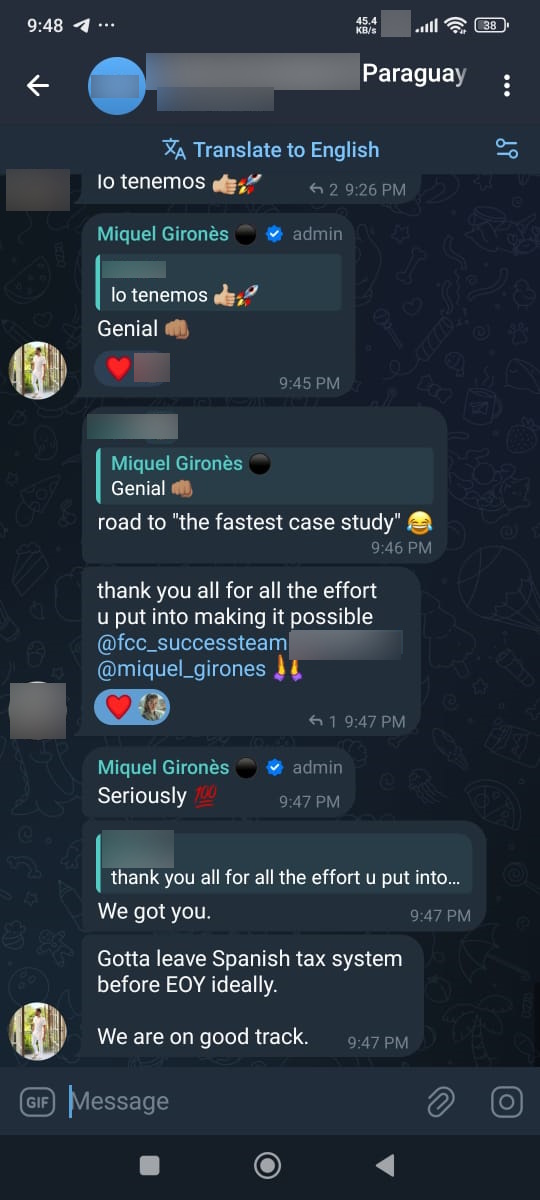
Real client wins, straight from the Hall of Wins.
The rest of the picture
- Find your routeTell it what you are trying to do and it maps the guides to read in order.
- ITIN document checklistPick your situation, get the exact list the IRS accepts.
- What it costsPublished prices and timelines, service by service.
- US credit calculatorWhat your spend returns at the rates issuers publish today.
FAQ
What is the difference between Mexican and Paraguayan residency?
Which one is faster?
Do I have to travel for either of them?
What documents does each one need?
Which one leads to a passport sooner?
What does each one cost?
Does either residency expire?
Does Paraguayan residency give me access to the rest of Mercosur?
Work out which of the two routes fits your case
The assessment call establishes which of the two you are actually buying, which of the competing timelines applies to your file, what your own situation changes about the paperwork, and what the pages do not publish about price. Direct, qualified, and honest about the parts no page can answer.
Book Your Assessment CallThis guide reports what the authorities and institutions involved publish, quoted, with the date each source was read. It is not tax, legal or immigration advice. Published rules change, and an individual case can turn on facts no page can see.

Founder & CEO, The First Class Citizen